
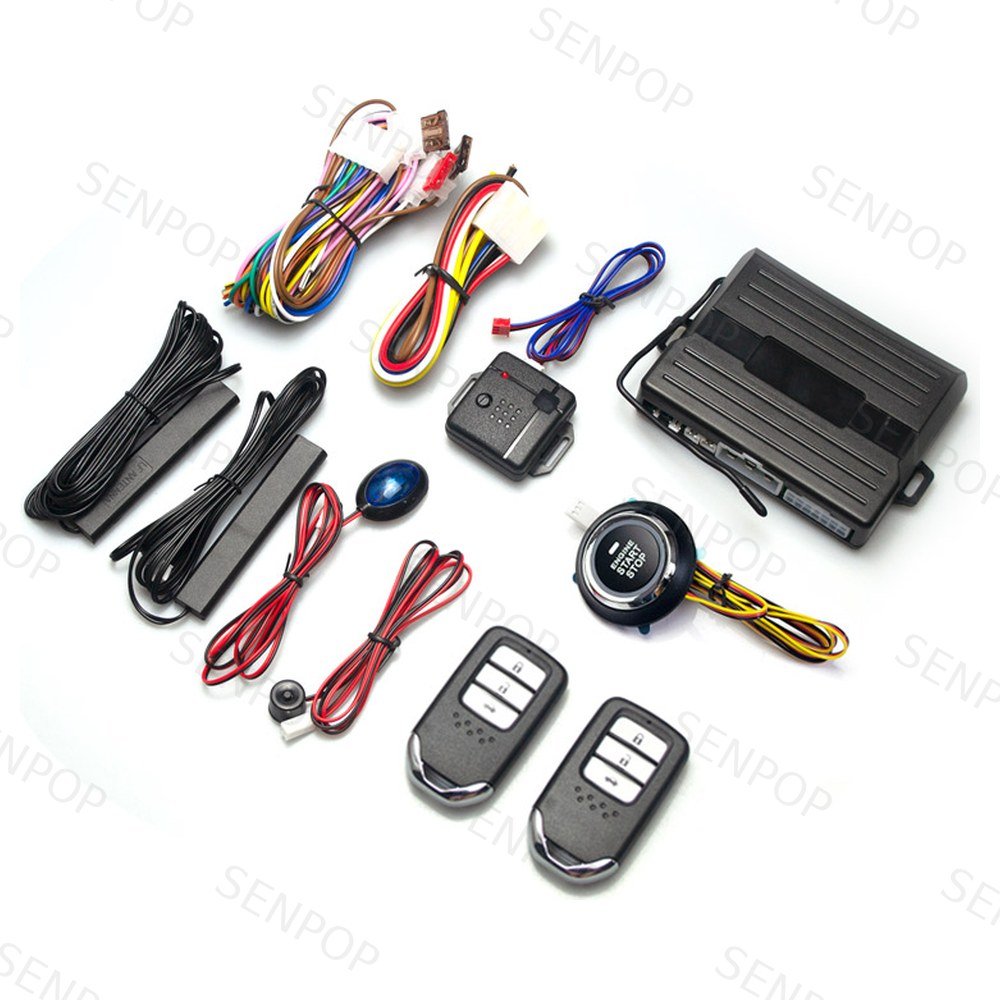
A one-way car alarm sends from the remote to the car. A two-way car alarm also sends back — the remote confirms whether the car actually locked, armed and, on some models, whether it was disturbed. That is the entire functional difference. Everything else in a comparison table is a feature count, and feature counts do not predict what comes back to you as a return.
For a distributor deciding what to stock, the useful question is not "which is better" but which one costs me less after the sale. This article answers it in that order: what the difference physically is, what it changes on the bench, what it changes commercially, and where our own alarm sits.
The Only Real Difference
Direction of the radio link
| One-way | Two-way | |
|---|---|---|
| Radio link | Remote → car | Remote ↔ car |
| What the customer learns | That they pressed the button | Whether the car received it, and what state it is in |
| Confirmation | Siren chirp, indicator flash, LED | Those, plus a signal on the remote itself |
| Remote hardware | Transmitter, button, battery | Transmitter + receiver + display or vibration alert, battery |
| Failure mode | Silent — you press, the car may not have heard | Visible — the remote tells you it did not confirm |
That last row is the whole argument, and it cuts both ways. A one-way alarm can fail silently: the customer presses lock, walks away, and the car was never armed — because a door was ajar, the remote was out of range, or the receiver was shadowed. A two-way alarm covers that gap. It also introduces a new failure mode: a remote that shows nothing because its own battery is low, which the customer reads as "the car is not locked" when the car is fine.
Why the feature list misleads you
Open a two-way datasheet and you will find twenty or thirty more lines than a one-way of the same platform: multi-page display, clock, temperature, voltage readout, per-zone trigger history, timer functions.
None of that is what the buyer pays for. They pay for one sentence: "did my car lock?" Everything else is surface. And every additional line on the datasheet is an additional thing to explain, to support, and to fail.
The rule that survives the whole category: buy the confirmation. Do not buy the dashboard.
What Changes on the Bench
Wiring: almost nothing
This is the part installers overestimate. The car side of a two-way alarm is the same car side as a one-way: main unit, siren, shock sensor, central-locking trigger, door triggers, indicator flash, power and ground. The two-way capability lives in the main unit's transceiver and in the remote, not in new car wiring.
What actually differs on the car:
- Antenna placement becomes critical. A one-way receiving a weak press still works, because the customer can press again from closer. A two-way that cannot transmit its confirmation back shows the customer nothing, and they conclude the alarm is broken. Weakness that was invisible becomes visible.
- Some units want the antenna away from metal and away from the main unit. Follow the harness instructions for the specific model; this is not a place to improvise.
Remote pairing: two-way is slower
Pairing a one-way remote is a short procedure — enter learn mode, press the remote, done. Pairing a two-way is the same idea with more steps, because both directions have to be taught: the remote has to learn the unit's identity, and the unit has to accept the remote's. Expect more ignition cycles and a longer sequence, and expect it to be documented differently by each manufacturer. On a bench with a queue, this is minutes per car, not seconds.
The LCD remote is the weak point
This is the strongest practical argument, and it has nothing to do with quality. A two-way remote contains, in the customer's pocket, a display, more buttons, a receiver that must stay powered to hear the car, and a larger battery to feed both. Every one of those is a wear item, and they fail in ways the customer blames on the alarm rather than on the remote:
| What the customer says | What it usually is |
|---|---|
| "The alarm stopped working" | Remote display dead or battery flat |
| "It doesn't beep any more" | Remote receiver fault; the unit is still arming fine |
| "It arms sometimes" | Remote battery at the edge, or damaged antenna in the remote |
| "It got wet and now it's dead" | Case seal — which a larger case with a screen makes harder to keep |
A one-way remote is a button, a battery and a transmitter. There is very little in it to fail, and when it does, the diagnosis is unambiguous.
Installation time difference
Small at the wiring stage, real at the handover stage. A two-way handover includes explaining the display, what each icon means, how to read a trigger history, what to do when the remote shows nothing, and how to charge or replace the battery. That conversation is ten to fifteen minutes on a good day.
Budget it. If you are quoting a fixed installation price, a two-way job is not the same job.
What Changes Commercially
Unit cost and margin structure
A two-way kit costs more at wholesale, and it retails at a higher price — but the margin percentage is often similar or thinner, because the extra cost is concentrated in the most expensive component: the remote. The consequence for a distributor is cash flow, not margin: the same working capital buys fewer two-way kits, and each unsold two-way kit ties up more money than an unsold one-way.
Spare parts: the remotes are the SKU you forget
Whichever way you go, remotes are the part that comes back, and they are the part you cannot substitute across models. A customer who loses or destroys a remote does not want a new alarm; they want one remote, matched to the unit already on their car.
- Order spare remotes with the first order, not later. Later means a separate shipment and a customer waiting weeks.
- Stock spares in proportion to how complex the remote is. A two-way remote has more to break, so the spare ratio has to be higher — but the right ratio depends on your market, your installers and your returns history. We will not give you a number we have not measured on your market.
- Keep the pairing procedure written down in the language your installers read. A spare remote that nobody on site can pair is not a spare.
Warranty exposure
A one-way alarm's warranty claims concentrate on the siren and the shock sensor — both cheap, both replaceable without touching the remote. A two-way alarm's claims concentrate on the remote. That single component carries the display, the receiver, the buttons and the battery, and it lives in a pocket, a bag or a cupholder. It is also the component the customer is most emotionally attached to, because it is the thing they look at.
So the warranty question to ask any supplier is not "how long" but "what is the remote's replacement policy, and how fast".
Choosing by market
| Type of market | What usually fits | Why |
|---|---|---|
| Price-sensitive retail / open market | One-way | The customer is buying "an alarm", not a confirmation system. Every extra unit cost is a lost sale |
| Fleet and commercial vehicles | Two-way, if the fleet manager is the buyer | Walk-away confirmation has real operational value when thirty vehicles are parked in a yard and one person locks up |
| Dealer / 4S channel | Either — follow the vehicle price band | On a cheap car a two-way remote looks out of place; on an expensive one, customers expect the display |
| Online / e-commerce | One-way, unless your listing copy can carry the support load | Returns on two-way are remote-driven, and remote-driven returns are the hardest to argue in a marketplace dispute |
| Install shops selling to end users | Two-way where the shop can demonstrate it | The confirmation is a demo feature — it sells itself on the counter, which is exactly where a one-way is hardest to differentiate |
Five questions for any alarm supplier
- Is this model one-way or two-way — and which specific component provides the feedback?
- What is the remote's replacement price, and what is the lead time on a single spare?
- What is the remote battery type, and is it user-replaceable without tools?
- Can the same remote be re-paired to a different unit, or is it locked to one?
- Which functions are documented as supplier-confirmed, and which are the supplier's own marketing claims?
Two red flags in a datasheet
- A function count with no function names. "38 functions" tells you nothing. Ask for the list, and check whether the list documents how each function is triggered.
- Two-way claimed with no mention of the return path. If a model is described as two-way but the specification never mentions a receiver, a display or a feedback alert in the remote, the word is being used loosely.
Where the SENPOP 606 Sits
A one-way alarm, stated plainly
The 606 is a one-way universal car alarm. Our own product page states it plainly: "the 606 is a one-way car alarm controlled both by remote and by smartphone APP."
What it carries, per the supplier-confirmed function list:
- Arming and disarming with sound; mute (silent) arming and disarming
- Vehicle locator with panic, overtaking and emergency-call sound modes
- Automatic central door locking, plus ignition-controlled lock/unlock
- Shock sensor (built-in vibrator)
- Un-closed door reminder, dome-light suspend, auto re-arming, arming-setting reminder
- Remote trunk release, remote code learning
- Anti-hijacking, anti-robbery mode, pulse arming, valet mode, emergency override
Two protection modes are selected by jumper on the unit — anti-hijacking (J4) and anti-robbery (J3 & J4) — together with an emergency disarm procedure. That is a bench-configurable setting, not a remote menu, and it is worth showing the installer where the jumpers are before the unit goes behind the dash.
The Bluetooth APP version adds app-only functions on top of the same list: app keyless entry, app switch lock, app trunk release, app car search. The remotes still operate the full function set on their own — the app is an additional control path, not a replacement. Remote link is 433.92 MHz. Kit contents: main unit, siren, shock sensor, two remotes, LED wire, emergency switch, relay, 3P cable, compressing switch, English manual.
Why this model is one-way
Our product page gives the reason in its own words: the 606 is built around "the functions installers get asked for most … without the cost and complexity of a two-way paging remote."
Read that as a positioning statement rather than an engineering verdict. It says this SKU was scoped to the everyday set — arming, central locking, shock sensing, trunk release, anti-hijack — at a cost point that suits open-market distribution, and that the two-way remote was deliberately left out of that scope.
If your market needs two-way
We do not currently make a two-way model, and we are not going to describe one as if we do. If your market needs walk-away confirmation, here is what actually helps:
- Add a hidden immobilizer instead of a paging remote. The 101 locks the engine whenever its sensing card leaves range, and cuts the engine about a minute after the driver walks away with the card. It does not tell the customer the car locked — but it makes the car un-driveable if it did not, which is the outcome the customer was actually buying. This is a different product answering the same worry, and on a cost basis it is usually the better answer.
- Use a PKE kit where the alarm layer is already included. Kits such as the 8803 combine keyless entry with push button start and a shock-sensor alarm layer. The customer gets confirmation of a different kind — the car unlocks as they approach, so they know the system is alive.
- Buy two-way from a supplier who makes it, and buy the spares with it. If the confirmation display is the requirement, source it deliberately: one model, one remote type, a spare ratio agreed up front, and the pairing procedure in writing. Do not mix two two-way brands in one catalogue; the remotes will not be interchangeable and your support burden doubles.
Is the 606 your only alarm?
No. The 101 is a hidden immobilizer — a different product with a different failure mode, and the two are not alternatives to each other. See the full car alarm and security systems range for what else is in the line.
Frequently Asked Questions
Does a two-way alarm stop theft better?
No. It tells the customer what happened; it does not prevent anything a one-way prevents. The theft-relevant parts — shock sensing, door triggers, engine immobilisation, siren — are the same on both. If you want a stronger theft answer, add an immobilizer; do not pay for a display.
What happens if the LCD remote battery dies?
The car stays armed; the remote goes quiet. On most two-way systems the customer can still disarm with the second remote, or through the app if the model has one, or with the emergency override procedure. The problem is not the car — it is that the customer reads a blank remote as a broken alarm. This is the single most common two-way support call, and it is worth writing the answer on the handover card.
Can I mix one-way and two-way in the same product line?
You can, and many distributors do. What you cannot do is mix remote types within one two-way brand and expect spares to be interchangeable. Keep one two-way model per brand, keep its spares, and keep the pairing sheet.
Is the 606 the only alarm you make?
No — the 101 hidden immobilizer is the other, and it solves a different problem. The 606 is the alarm platform; the 101 is the anti-drive-away layer. See all car alarm systems.
What should I stock for a price-sensitive market?
One-way, and put the saved unit cost into spare remotes and a written pairing procedure. The complaint that actually costs you money in that market is "my remote stopped working", not "my remote doesn't show me the car".
A note on what this article will not tell you
We have not measured return rates for one-way versus two-way across markets, because we do not have that data. The statements above about where returns concentrate are based on which component carries the complexity in each design, and on how those components behave in service — not on a returns study.
If you want the number rather than the reasoning, measure it in your own market: track returns by component for two quarters. That number will be more useful to you than any supplier's claim, including ours.
Tell us your market and we will tell you what to stock
Send us the market, the channel (retail, fleet, dealer, online) and the price band you sell into, and we will tell you whether a one-way alarm plus a hidden immobilizer, or a PKE kit with an alarm layer, is the better fit for what your customers actually ask for.
Ask about the 606 or the 101 →Related Reading
- PKE vs RKE Keyless Entry: Which System Fits Your Business? — the same "choose by channel, not by feature list" logic applied to entry systems
- Universal vs Vehicle-Specific PKE Kits: A Dealer's Guide — where a universal SKU genuinely wins and where it does not
- Universal Car Alarm System with Anti-Hijacking — 606 — the full supplier-confirmed function list
- Hidden Car Immobilizer — 101 — the anti-drive-away layer, and why it is not a substitute for an alarm