
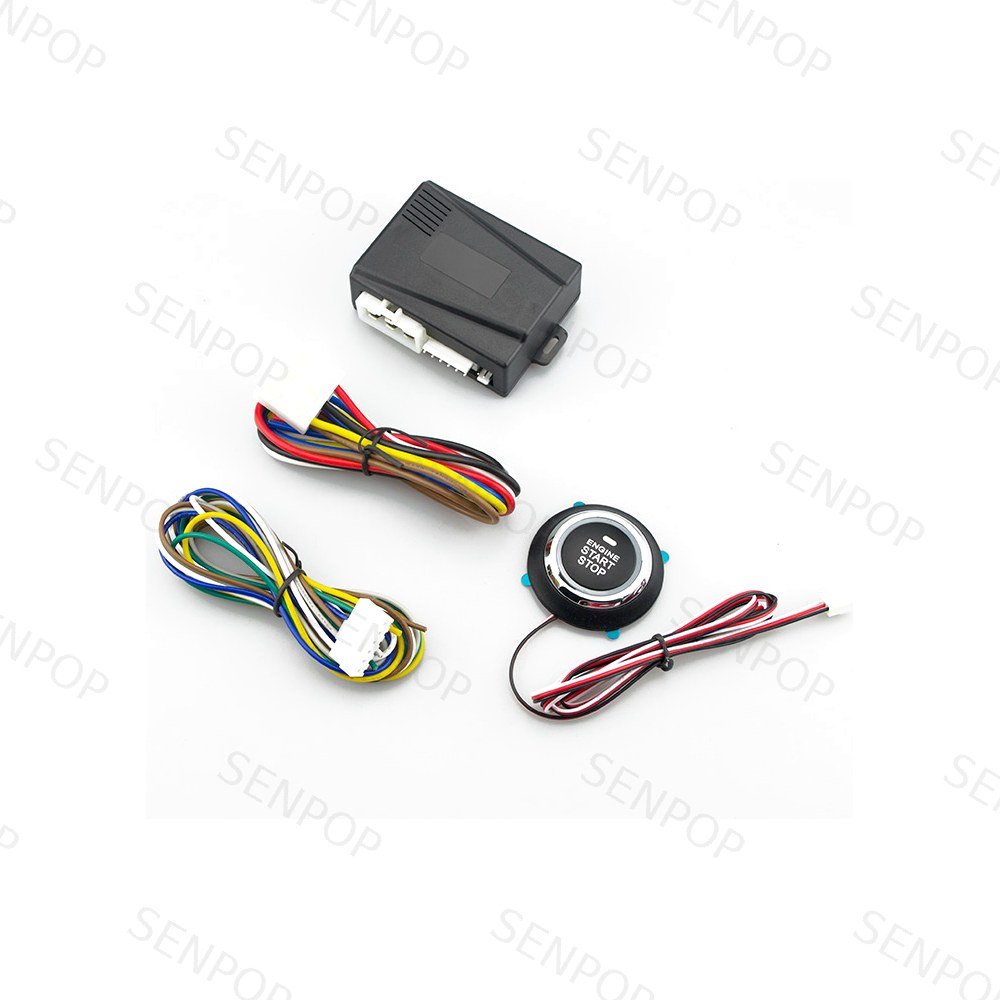
Short answer: no, you cannot fit a 12V kit to a 24V truck with a converter and call it done. The voltage is the easy part. What actually differs is where you take power, what happens to the two batteries underneath, whether the engine needs to glow before it cranks, and what the vehicle is supposed to do after it starts.
This article is the 24V follow-up to the general kit-selection criteria. That article spends one line on voltage. This one spends the whole page on it, because on a commercial vehicle voltage is not a checkbox — it decides the wiring, the relay, the start sequence and, in the worst case, whether the customer comes back in eight months with two dead batteries.
Four Differences, Not One
Most buyers ask "is there a 24V version?" and stop there. The 24V version exists; that is not where the problems are.
Difference 1 — Two batteries in series, and a tempting middle wire
A conventional 24V diesel truck is not one 24V battery. It is two 12V batteries in series. The junction between them sits at 12V relative to the chassis, which means a wire taken there does deliver a working 12V supply — for free, with no converter. This is the most common way people take 12V off a truck, and it is the one that quietly destroys the battery pair.
The reason is simple once you see it: the alternator charges the two batteries as one 24V string, but a load on the midpoint draws from the lower battery only. That battery is discharged harder every cycle and never brought back to the same state of charge. The pair drifts apart. The weaker battery then gets worked harder still, ages faster, and drags the string down.
The outcome is not a failed accessory. It is a pair of batteries replaced early, and because they are replaced in matched sets, the bill is for both. Vehicles come back with the fault recorded as "battery problem", and nobody looks at the wiring that caused it.
This matters for a push button start kit specifically, because the kit's own electronics have to be fed from somewhere. If you are installing any accessory on a 24V vehicle, the correct feed is across the full 24V bus through a converter or equaliser — not a midpoint tap. Where a specific kit takes its supply is a question to confirm for your installation, not something to assume from a photo of the harness.
Difference 2 — Half the current for the same load, but the relay is not interchangeable
For the same power, doubling the voltage halves the current. Conductor loss falls with the square of the current, so the same load on 24V has roughly a quarter of the resistive loss it would have on 12V. That is why commercial vehicles run 24V in the first place: thinner cable, less voltage drop over a long chassis.
The trap is the opposite direction. A 12V relay coil will not pull in reliably on 24V, and a 24V coil will not pull in on 12V. Anything in the kit that switches — relays, the main unit's internal switching, the button's backlight circuit — has to be the 24V variant. This is the single most common reason a "it should work" installation does not.
Difference 3 — The engine may need to glow before it cranks
On a diesel, the key does not go straight to start. It goes to ON, the glow plug relay energises, a "wait to start" light comes on, and only when it goes out does the operator crank. Pre-heating is typically a few seconds on a modern engine and longer in cold weather, and cranking while the plugs are still heating shortens glow plug life.
Here is why this matters to a push button kit: a button replaces the key, and the key was carrying that sequencing. If the button simply cranks the moment it is pressed, the driver has lost the wait. Whether that is a problem depends on whether your vehicle's glow control stays in the vehicle — most do, because the glow relay is triggered by the ignition ON position, not by the start signal — or whether the kit is expected to sequence it.
That is a question, not an answer. We do not publish a glow-plug delay figure for the S9001X, and we are not going to invent one. What we can tell you is what to ask before you buy: does the kit hold the ON position before cranking, and for how long? If the answer is "it cranks immediately", the kit is fine on a petrol or a warm-climate diesel that starts without glowing, and wrong for a cold-climate diesel where the driver habitually waits.
Difference 4 — What happens after it starts
A passenger car's start sequence ends at "engine running". A commercial vehicle often has a second requirement: idle before shutdown. Turbochargers on a working truck spin fast and hot; shutting down immediately after a loaded run leaves oil pressure gone while the turbo is still spinning. Fleets handle this with a cool-down idle, either by driver discipline or with a turbo timer.
A push button kit changes the shutdown path, so this is the moment to ask whether the fleet's cool-down habit survives the change. If the driver used to sit for two minutes before turning the key off, does pressing a button make that easier or does it invite an instant press? It is a small design detail that decides whether a fleet manager approves the retrofit.
The table buyers actually need
| Item | 12V passenger car | 24V truck / bus | What goes wrong if you treat them the same |
|---|---|---|---|
| Battery | One 12V battery | Two 12V in series | 12V taken from the midpoint drains one battery only; the pair fails early and both get replaced |
| Feed for accessories | Battery positive | Full 24V bus, converted or equalised | Midpoint tap — same failure as above, and it looks like it works for months |
| Current for the same load | Double | Half | Wiring sized for 12V is over-specified; wiring that assumes "24V means less current everywhere" undersizes the start circuit |
| Relay coil | 12V | 24V | 12V coil on 24V: chatter, heat, eventual failure. 24V coil on 12V: does not pull in |
| Diesel pre-heat | Usually not applicable | Often required, longer when cold | Button cranks before the glow completes; hard starting and shortened glow plug life |
| Shutdown | Key off | Often idle-then-off | Turbo cool-down habit breaks; the fleet notices in the workshop, not at delivery |
| Ground | Negative earth | Almost always negative earth, but not universally | Reversed polarity on an old positive-earth vehicle destroys the unit on first power-up |
Where to Take Power on a 24V Vehicle
The three points, and which one is a trap
On a series pair there are three places you can attach a wire:
- Across both batteries (+ of the upper to − of the lower) — this is the 24V bus. Correct for anything rated 24V.
- From the midpoint to chassis — this reads 12V and it is the trap. It works, and it is why people keep doing it.
- Across the full bus, through a converter or equaliser — this is how you get a correct 12V supply. The equaliser draws across the whole string, so both batteries stay balanced, and it can actively correct a pair that has already drifted.
If a vehicle already has a midpoint tap — a radio, a dash camera, a telematics box — the damage may already be running. A battery equaliser is the item that stops it and, depending on the unit, pulls the pair back into balance.
Fuse rating on 24V
Two things change when you move to 24V. The current for a given load halves, so a fuse chosen "to match the 12V one" is oversized for the circuit and will not protect it. And the interrupt rating has to suit a 24V DC arc, which behaves differently from 12V. Take the fuse figure from the kit's own manual for the specific circuit; do not scale it by eye.
Ground: negative earth, with one exception worth asking about
Almost every modern truck, bus and piece of plant is negative earth — the battery negative is bonded to the chassis and the chassis is the return path. The exception is older vehicles, where positive earth appears. On a positive-earth vehicle, connecting a negative-earth unit means the first power-up is a dead short through the electronics.
We are not going to claim the S9001X handles both. We ask before quoting, because it is a two-second question that prevents an expensive return. If you do not know, tell us the vehicle's make, model and year and we will ask the right question rather than guess.
What a Datasheet Cannot Tell You
"Fits 99% of DC 24V vehicles" is a supplier rating, not a test result
The S9001X product page states it plainly: the supplier rates the system to fit 99% of DC 24V vehicles on the market. Read that sentence for what it is. It is the supplier's own compatibility statement, covering the voltage class and the common commercial-vehicle architecture. It is not a per-vehicle fitment list, it is not a test report, and it does not tell you whether your customer's 2009 tipper with a positive-earth loom is inside that 99%.
We do not extend that claim. We will not tell you a specific model is covered unless the version for it is confirmed.
The five things we ask before quoting a 24V order
- Vehicle type — truck, bus/coach, van, or off-highway plant. Not a model, a class, because the class tells us the architecture.
- Confirmation the vehicle is DC 24V. Sounds obvious; it is the most common wrong assumption when a customer says "it's a big truck".
- Ignition type — key start, or an existing button. And whether the engine is diesel.
- Which functions are actually wanted — start/stop only, or remote start as well. The S9001X does remote start through the vehicle's original remote control, not through an extra fob, which is either exactly what a fleet wants or a deal-breaker, depending on the customer.
- Ground polarity if the vehicle is old — see above.
Answer those five and the quote is straightforward. Skip them and the first order becomes a sample order whether you meant it to or not.
Which Fleets Buy a 24V Push Start
Trucks
The obvious case. What the button changes for a driver is small — one less key turn — and what it changes for a fleet is not: no key barrel to wear out, no key to lose, and remote start that warms or cools the cab before the driver reaches it. That last one is the feature that sells in a hot or cold climate, not the button itself.
Buses and coaches
A different driver every shift, often a different key. Removing the key from the ritual removes a whole category of administrative problem: no sign-out log, no missing key at 5am, no barrel replacement on a vehicle that does forty starts a day.
Off-highway and construction plant
Where the button is less about convenience and more about surviving an environment — dust, vibration, operators wearing gloves. Physical button format matters as much as the electronics here.
Where the interest is coming from
car push start is the one push-start phrasing that carries the word "car" and still has volume, and its regional distribution is not North American. It reads as: Zambia, Ghana, South Africa, Kenya, Pakistan, Nigeria at the top.
That is a statement about the search term, not about our customer list — we are not going to tell you "our clients are in these countries" when the evidence is a trends index. What it does say is that the commercial-vehicle aftermarket in those markets is where a 24V-specific SKU has an audience, which lines up with the vehicle mix on the road there.
Frequently Asked Questions
Can I use a 12V kit with a 24V-to-12V converter?
A converter solves the supply voltage for the kit's electronics. It does not solve the start circuit — the current path through the ignition switch and the starter relay is a 24V circuit, and a 12V-rated switching element in that path is the wrong part. Whether a specific 12V kit can be adapted depends on its internal switching design, and we would not recommend planning a commercial retrofit around an adapter when a 24V unit exists.
Does the S9001X work on a diesel?
The product is a start/stop system for DC 24V vehicles and the supplier's compatibility statement covers commercial vehicles generally, which in this voltage class usually means diesel. What we will not do is tell you it sequences a cold-start glow, because we do not have that confirmed. Ask us for the vehicle and we will tell you what we can confirm and what we cannot.
Is it plug-and-play?
The supplier describes easy DIY installation with a standard 6P harness set. For a retail customer we still recommend professional installation — the harness is standard, the vehicle is not. And the wiring should always follow the manual supplied with the unit, not a generic diagram from the internet.
What if the truck is positive earth?
Tell us before ordering. Do not connect it and see what happens. If the vehicle is positive earth and the unit is negative earth, the first power-up is a short.
Does it work with the vehicle's existing remote?
Yes — remote start and stop use the vehicle's original remote control, with no additional fob supplied. That is the design, and it is worth confirming with the customer that they are happy to keep their original key habits, because some buyers expect a new remote in the box and are surprised when there is not one.
Can I order a small quantity to test?
MOQ is 5–10 pcs per model, and mixed models can be combined in one order. A 24V kit and a 12V kit in the same order is a normal test order for a distributor serving both passenger and commercial customers. Details are on the wholesale page.
Tell us the vehicle class and we will confirm what fits
Send us the vehicle class, the voltage and whether it is diesel, and we will confirm what the S9001X can and cannot do for that fleet — including the questions above that a datasheet does not answer.
Ask about the S9001X 24V system →Related Reading
- How to Choose a Push Button Start Kit — the general selection criteria; this article is the 24V deep dive
- S9001X 24V Push Button Start System — the full supplier-confirmed specification
- 9002 RFID Push Button Start & Hidden Immobilizer — the 12V equivalent for passenger cars
- All Push Button Start Systems — the full range
Sources
Technical statements on series-battery midpoint taps, current/loss relationships and diesel glow timing follow published industry references: heavy-vehicle electrical wiring guidance (TAPS, Australia) on 12V loads from 24V systems; battery-equaliser technical literature (Micropower Group; YLTronics) on midpoint-drain failure and balancing; glow plug operation references (Bosch-sourced summaries) on pre-heat timing and the wait-to-start sequence. SENPOP has not independently measured return rates or battery-life figures; the statements above reason from component behaviour, not from a returns study.