
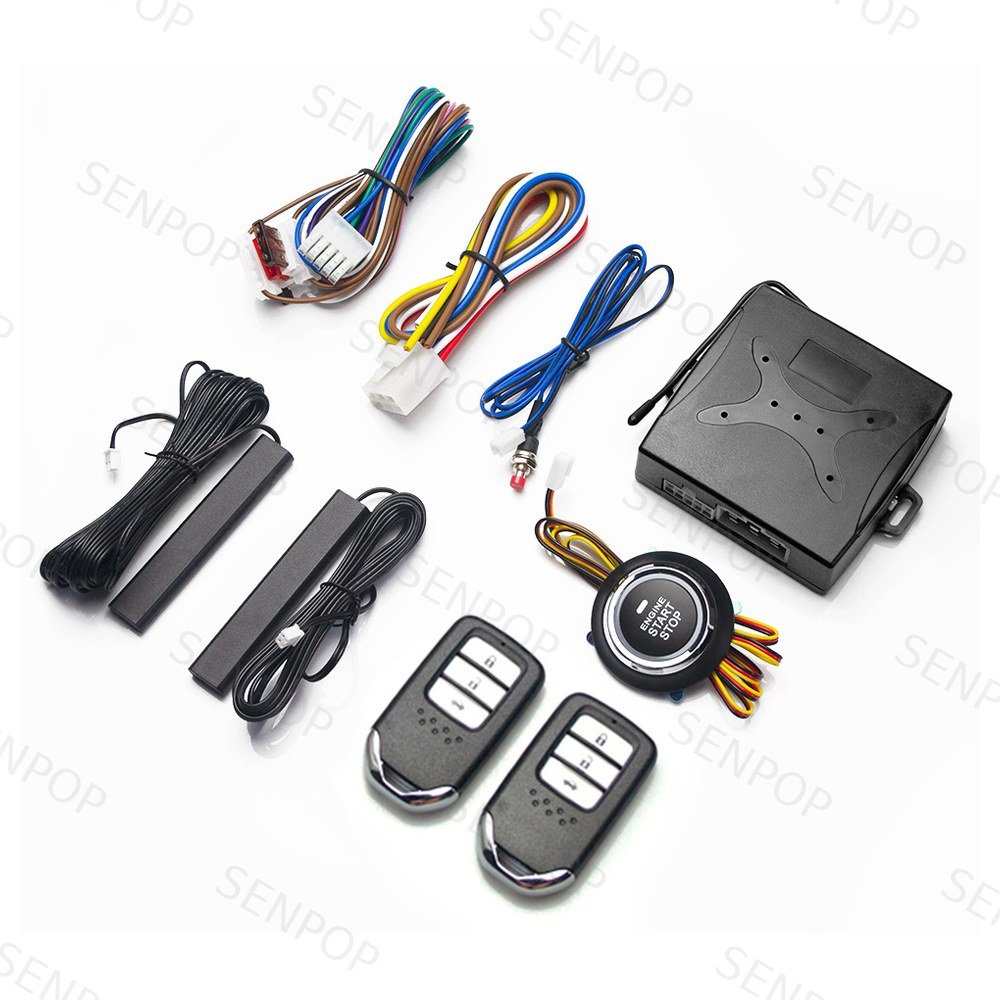
Ask three PKE listings for their detection range and you will get three incompatible numbers — a 1.8 m figure on one product, a 30–80 m claim on another, and a 3–5 m figure on ours. None of them is lying. They are answering different questions, under different conditions, and two of them are not even measuring the same thing.
This article separates the questions. What the number on the box actually promises, the four variables that move a real installation away from it, how to measure range so the measurement means something, and what to do when a customer says "it doesn't work from far enough away."
A boundary first: our article on relay-attack defence covers where to place PKE antennas for security — which zones to sense and which to sleep. This article is about how far the sense reaches and why your installed range will not equal the datasheet range. Read that one for placement strategy; this one for distance expectations.
What the Number on the Box Means
Three different numbers travel under the words "range":
| Number | What it measures | Typical figure | Commonly confused with |
|---|---|---|---|
| PKE detection range | How far away the LF link wakes and authorises the key — passive, both directions matter | Roughly 1.5–5 m depending on platform and conditions | Remote-control distance |
| Remote (RKE) range | One-way RF from the fob to the receiver | Tens of metres; open-environment claims run higher | PKE detection |
| Card / coil read range | Deliberate short-range authorisation — a security feature, not a limitation | Centimetres (our 9002 reads its card at 12 cm by design) | Both of the above |
The 30–80 m figures you see on marketplace listings are remote-control distances. The ~1.8 m figures (some listings state "maximum PKE range 6 feet") are PKE detection distances under the seller's conditions. When a buyer compares those two numbers side by side, the comparison is meaningless — and it is your job, as the importer, to know which is which before your customer asks.
Our own numbers, stated with their sources: the 8808BLE is specified at 3–5 m for automatic phone/remote recognition, with its remote reaching 100–150 m in open environments — note those are two different radios doing two different jobs. The 8803's manual documents the same shape of behaviour: arm at 3–5 metres from the car, disarm within about 2 metres. Models where we have not published a detection figure (the 8803BT, the 8807) simply have no verified number yet — ask us rather than assume. And the 9002's 12 cm figure is a card read at a coil, a different mechanism entirely.
Four Things That Change It
Take any PKE kit, install it four different ways, and you will get four different real-world ranges. Four variables do most of the moving:
1. Antenna orientation
The LF field from a PKE antenna is not a sphere — it is shaped like a flattened doughnut around the coil. An antenna mounted with its face vertical throws most of its field at the doors and windows; the same antenna face-down under the carpet spends its field on the floorpan. Same unit, same cable, noticeably different approach distance. This is the single most under-documented variable in the whole category.
2. Body metal and glass
The LF field has to reach the key outside the car, which means crossing body panels. Metal eats field; glass passes it far better. Two identical installations — one with the antenna behind a plastic sill trim near a window, one buried under the metal crossmember — will not behave the same. Where the field exits the car matters as much as how strong it was to begin with.
3. Remote battery voltage
The LF wake is one direction of the exchange, but the key's reply is a two-way conversation — and a tired CR2032 answers weakly. A kit that unlocks at a consistent 4 metres on a fresh remote can drop to 2 on one that has been through a summer. When a customer reports "the range got shorter over months", the remote battery is the first suspect, before any re-wiring.
4. Ambient RF and electrical noise
Parking next to a transformer room, a powerful transmitter, or a row of vehicles all running chargers and inverters raises the noise floor the system must talk over. The effect is usually intermittent — the kit works perfectly in the suburb and struggles in the basement of a shopping centre — which is exactly why it gets reported as "sometimes it doesn't work" rather than "the range is short".
Bench vs On-Car Measurement
A datasheet figure is nearly always a bench or open-field figure: unit powered on a stand, key approaching on its own, no car around it. Your installation will never reproduce those conditions, so the only number worth managing is the one you measure on the actual vehicle. The procedure takes ten minutes:
- Fix the variables you can. Fresh remote battery. Doors closed. Engine off. A second person holding nothing electronic.
- Approach the same way every time. Walk toward the driver's door at a normal pace from beyond the expected range, and note where the locks fire. Do it five times; throw out the fastest and slowest.
- Walk away, too. Arm distance (walking away) is usually longer than disarm distance (approaching) on most platforms — on the 8803 the manual documents exactly this shape: 3–5 m arm, 2 m disarm. Measure both, because customers experience both.
- Write down the conditions. Vehicle model, antenna positions, remote battery age, location. A range figure without its conditions is an anecdote.
This is why we have not published a single "measured range" table across our models: a number measured on one hatchback with one antenna position tells you nothing defensible about a sedan with another. What we can promise is the specification band — and a method you can run on the vehicles you actually sell into.
Antenna Placement Rules (the Distance Part)
The relay-attack article covers placement for security — which zones should sense and which should sleep. For distance, three rules follow from the physics above:
- Face the coil toward where the human will be. Door-side antennas face the window line; boot antennas face the tailgate. The doughnut's widest part should cross the glass, not the floor.
- Keep the antenna cable run within the kit's documented length and away from high-current wiring. Extension beyond the supplied length shifts the LF tuning — we do not publish a maximum extension for our antennas precisely because it is unit-dependent; confirm with us for a specific kit before planning one.
- Do not chase range by adding antennas. Overlapping fields cause the exact problem you were avoiding — unlocking from the wrong side, or unstable handover between zones. If the range is wrong, fix orientation and position first.
"It Doesn't Work From Far Enough"
When this complaint arrives — and after enough units it will — work the list in order. It is the four variables, ranked by how often each is the guilty one:
- Remote battery. Cheapest, fastest, most common. Swap before anything else.
- Antenna position changed at installation. Compare against another unit of the same model; if only this car is short, the installation is the difference.
- Location-specific noise. Ask where it fails. "Everywhere" means hardware or battery; "only at the office basement" means environment, and no rewiring will fix a building.
- Genuine unit fault. Last, as always. If two cars with identical installs behave differently and both have fresh batteries, then we talk about replacement — through the channel the units were bought through, with the model and batch in hand.
Notice what is not on the list: "turn the sensitivity up". Most kits in this class do not expose a range adjustment, and the ones that do trade range against false unlocks — the system waking when a bus drives past is a worse complaint than a short approach.
Frequently Asked Questions
Why do other brands claim much longer PKE range?
Two reasons, both visible in the listings. Some quote remote-control distance under the PKE heading — 30–80 m figures are fob-to-car radio, not passive detection. Others quote a bench maximum with a fresh battery and no body panels in the way. Neither number survives contact with a real installation, which is why we publish platform bands (3–5 m on the 8808BLE) rather than best-case peaks.
Is a longer PKE range better?
Not automatically. Range is a security surface: whatever distance the car authorises from, a relay setup can potentially abuse. Long detection plus poor zone design is worse than moderate detection with sensible zones — the placement logic is in our relay-attack article.
Can I extend the antenna cable to move the antenna?
Do not improvise it. The LF antennas are tuned with their cable; extending or re-routing beyond what the kit supplies changes the tuning and the range in ways that are hard to predict. If your installation needs a different cable length, tell us the kit and the target position and we will confirm what is possible for that model.
Does the 9002's 12 cm mean it is a weaker PKE?
It is not a PKE at all. The 9002 authorises with a passive RFID card read at 12 cm from a hidden coil — a deliberate touch, chosen so the card cannot be intercepted over the air. Comparing 12 cm to a 3–5 m PKE figure compares two different mechanisms.
Can you give me a measured range for my vehicle model?
We give the specification band and the measurement procedure above; the on-car number depends on the vehicle and the install, which is yours to measure — ten minutes with a fresh battery and five approaches. If a result falls badly outside the band, that is exactly the kind of report we want, with the conditions written down.
Specifying for a market or a vehicle type?
Tell us the vehicle mix and the antenna positions you plan, and we will confirm which model's detection behaviour fits — and what to verify before you promise a range figure to your customers.
Contact SENPOP →Related Reading
- How PKE Keyless Entry Works — the two distance zones and the authorisation chain behind them
- Relay Attack Defence for Aftermarket PKE — where antennas go for security (the companion to this article)
- Push Button Lit but Engine Won't Crank: 7 Checks — when the symptom is starting, not range
- All PKE Keyless Entry Systems — the full line